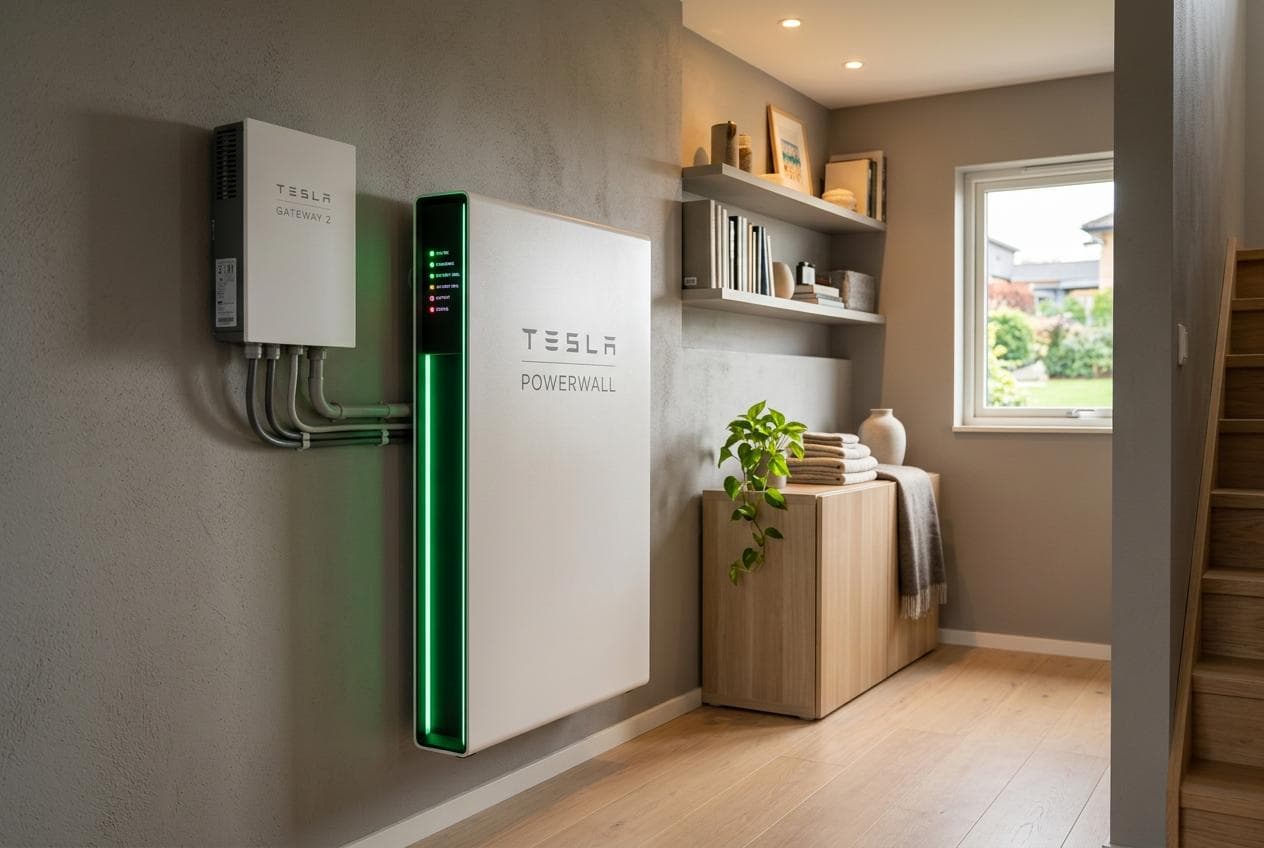
When a Home Battery Makes Sense
A home battery stores electricity so the house can use it later. It can charge from solar panels, from the grid, or from both, depending on the equipment the survey specifies. It is paired with an inverter. The useful question is whether that storage suits the way the house uses electricity. The quote follows the survey. This note does not promise a payback.
What the battery does
Panels generate while light is on the roof. A battery holds some of that electricity for later in the day. It can also charge when a tariff is cheaper, where the equipment and the tariff allow it. The unit is usually on a wall in a garage, a utility room, or outside, following the product's location rules. The service page is battery storage. The array is solar panels.
When storage is worth pricing
A battery is worth pricing when daytime solar would otherwise leave the house, and evening use is significant. It is also worth pricing when you are planning a heat pump or a home EV charger, because those loads change how much electricity the house uses. The battery still has to be sized to those loads. A small battery does not cover a heat pump and a car charger on its own.
A battery is a weaker fit when the array is small, when people are home and already use most of the solar as it is generated, or when electricity use is low. Say at the survey if you want the home supplied during a power cut. Many systems supply the home in a power cut only when they are designed and installed to do that, and only on the circuits named in that design. The quote states whether backup is included.
Questions for the quote
Ask how the battery size was chosen and which usage figures it used. Ask which tariff assumptions sit behind any savings estimate. Ask whether backup power is included, and for which circuits. Ask where the battery will sit, and what ventilation and temperature the product requires. Ask what the warranty says about capacity over time, and how you will see what the battery is doing. For an export tariff, the supplier asks you to show certification. An MCS certificate is the usual example for solar PV up to 50kW.
For a home solar system up to 50kW, the supplier asks you to show the kit and the installer are certified. An MCS certificate is the usual example. Other schemes that meet EN 45011 or EN ISO/IEC 17065:2012 also count. For systems above 50kW and up to 5MW, the guidance asks for a certificate for the installation.
Ofgem generator guidance · correct as of 3 October 2026
VAT
0% VAT on a home battery fitted at your home from 1 February 2024 until 31 March 2027. That covers a battery fitted with solar as one job, a battery added to solar, wind, or hydro, and a battery on its own that stores grid electricity. From 1 April 2027 the rate is 5%. If you only buy the battery and nobody fits it, VAT is at the standard rate.
VAT Notice 708/6 · correct as of 3 October 2026
Funding
The Home Energy Scotland table covers heat pumps, heat network connections, solar thermal, solar PV-T, biomass, wind, and hydro. Standalone solar PV and a home battery sit outside that list. The PV-T line is limited to solar PV-T systems. Check the page for the home before you rely on funding.
Home Energy Scotland Grant and Loan · correct as of 3 October 2026
Home Energy Scotland is the free advice service funded by the Scottish Government. The scheme page lists the measures and the current grant and loan rules. Read that page for the amounts. Where the funding pays for a renewable system, check that the installer and the product are MCS certified. Micro-hydro is the published exception. That check belongs to the application.
Home Energy Scotland Grant and Loan · correct as of 3 October 2026
Heat pump funding, if heating is part of the enquiry, is on the grants guide. Export payments for solar electricity are on the Smart Export Guarantee post. The supplier sets that rate.
The survey
We look at the existing or proposed array, the inverter, spare capacity at the consumer unit, a place for the battery, ventilation, and the cable route. The battery is installed to the manufacturer's instructions and the electrical work the survey records. The workshop is Unit 2b Eastfield Industrial Estate, Penicuik, EH26 8HA. The area note for the city is the Edinburgh page. How a battery sits beside an array is in home batteries with solar PV, and the visit itself is what happens on a solar survey. Get my quote asks for the survey.
Questions
When is a battery worth a survey?
When spare solar would otherwise be exported, evening use is significant, or a heat pump or EV charger is part of the plan. The size is set for that house.
Will it run the house in a power cut?
Only when the system is designed and installed to do that. Ask, and the quote names the circuits.
What VAT rate applies?
0% VAT on a home battery fitted at your home from 1 February 2024 until 31 March 2027.
VAT Notice 708/6 · correct as of 3 October 2026
Is there a battery grant to quote here?
A home battery is outside the list on the Home Energy Scotland table. Read the scheme page for the current list.
What MCS check applies?
For a home solar system up to 50kW, the export supplier asks you to show the kit and the installer are certified. An MCS certificate is the usual example. Where Home Energy Scotland funding pays for a renewable system, check MCS certification of installer and product.