What Happens on a Solar Survey
A solar survey is a visit to the house, not a price taken from a satellite photo. It records the roof, the shading, the loft where it can be entered, the consumer unit, and a place for the inverter. The quote is written from those notes. Homes are in Edinburgh and the Lothians.
Before the visit
Have a recent electricity bill or the annual use in kilowatt-hours, the EPC if you have one, and a note of plans for an electric car, a heat pump, or other new loads. Say if the building is listed or in a conservation area, and, in a flat or tenement, whether you own the roof outright. The ownership point is covered in solar on Edinburgh tenements and flats.
The roof
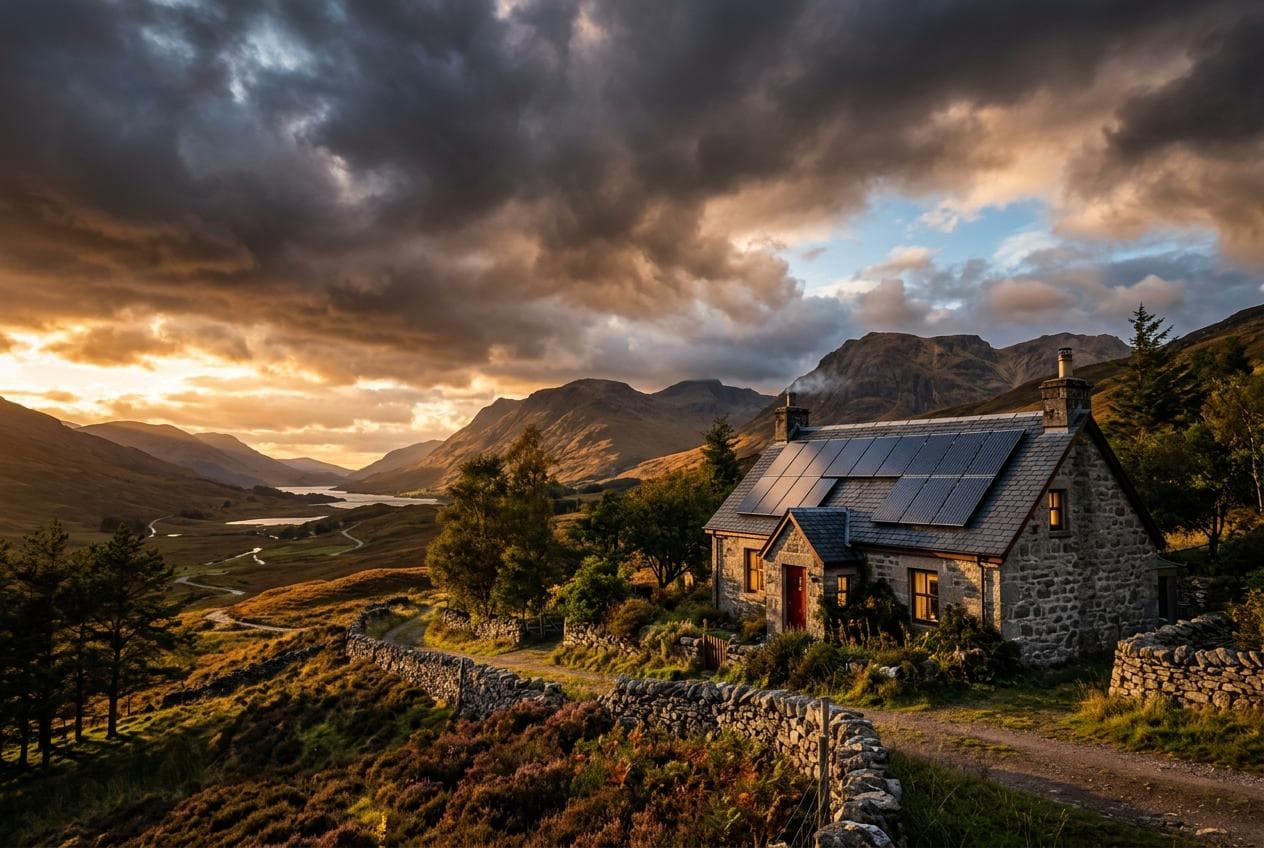
The survey records orientation, pitch, and the clear area after chimneys, vents, rooflights, valleys, and hips. It records shading from trees, chimneys, neighbouring buildings, and dormers, including shade that arrives later in the day. It records the covering. Slate, concrete tiles, and clay tiles use different fixings, and a Scottish slate roof is handled to suit slate. If the covering is near the end of its life, that work comes before the panels.
A south-facing pitch generates more across the year. An east or west pitch spreads generation into the morning or the evening, which can match when the house uses electricity. Flat roofs can take panels on frames. The layout in the quote follows the roof that was seen.
The loft and the electrics
Where the loft can be entered, the survey looks at rafter or truss size and spacing, the condition of the timbers, signs of damp or old leaks, and a cable route to the inverter. The electrical notes cover the consumer unit, the earthing, a place for the inverter, and a place for a battery if you want one priced. A smart meter is relevant if you later apply for export payments. The survey says whether the existing consumer unit can take the system.
The grid, the size, and permissions
The distribution network operator is notified where the connection rules require it. The quote names that step. This page does not set a kilowatt threshold. The array size follows the usable roof, your annual use, when you use electricity, and any heat pump or EV charger you want designed in. There is no single size for a Scottish house. The proposal gives an estimated annual generation for that roof and shading, and it separates generation from the share you are likely to use in the house.
You can usually put solar panels on your house without a planning application when they stick out by 1 metre or less from the wall or roof. You need to apply if the house is listed, in the grounds of a listed building, or in a World Heritage Site. In a conservation area, the panels go on the back of the house, or on a side that faces away from the road.
Scottish Government Circular 1/2024 (28 May 2024) · correct as of 3 October 2026
The survey flags when a planning application is likely. Scaffold and other access are noted, including where a scaffold would need a neighbour's land or a pavement. A pavement site can need a permit. That constraint is in the quote. Mention a battery or an EV charger at the visit if you want them designed in, even if they are installed later.
What you receive
The written proposal names the system, the panels and the inverter, the layout on the roof, the estimated annual generation, the electrical work, and the assumptions and exclusions. Ask about anything that is unclear. Warranties for equipment and workmanship are stated with the quote, for the products specified.
Your electricity supplier has to pay you for solar electricity you send back to the grid. This is the Smart Export Guarantee. It covers solar in Great Britain up to 5MW. The rate stays above zero. The supplier chooses the pence rate, how long the contract lasts, and how you apply. You can compare suppliers.
Smart Export Guarantee · correct as of 3 October 2026
For a home solar system up to 50kW, the supplier asks you to show the kit and the installer are certified. An MCS certificate is the usual example. Other schemes that meet EN 45011 or EN ISO/IEC 17065:2012 also count. For systems above 50kW and up to 5MW, the guidance asks for a certificate for the installation.
Ofgem generator guidance · correct as of 3 October 2026
Funding
The Home Energy Scotland table covers heat pumps, heat network connections, solar thermal, solar PV-T, biomass, wind, and hydro. Standalone solar PV and a home battery sit outside that list. The PV-T line is limited to solar PV-T systems. Check the page for the home before you rely on funding.
Home Energy Scotland Grant and Loan · correct as of 3 October 2026
On the Home Energy Scotland process, you confirm that installation works wait for a written funding offer. Check the scheme before you commit to an installation you want that funding to cover. Amounts are on the scheme page and on the grants guide.
Home Energy Scotland Grant and Loan · correct as of 3 October 2026
0% VAT on solar installs until 31 March 2027. From 1 April 2027 the rate is 5%.
VAT Notice 708/6 · correct as of 3 October 2026
The installation page is solar panels. Daylight on a Scottish roof is covered in solar panels in Scottish weather, and export payments are on the Smart Export Guarantee. The area note is the Edinburgh page. The workshop is Unit 2b Eastfield Industrial Estate, Penicuik, EH26 8HA. Book a solar survey on the quote form.
Questions
How long is the visit?
Long enough to see the roof, the loft where it can be entered, and the consumer unit, and to talk through how the house uses electricity. Allow time to be at home for that access.
Do I need to be there?
Yes. The survey needs the loft, the consumer unit, and the places an inverter or a battery might go.
Is an east or west roof worth surveying?
Yes. Those roofs generate less across the year than a south roof, and they spread generation into the morning or the evening. The quote uses the roof you have.
Can panels go on slate?
Yes, with a fixing method that suits slate. The survey records the covering.
Will I need a new consumer unit?
The survey checks the one you have and writes any upgrade into the quote.
What MCS check applies?
For solar PV up to 50kW, the export supplier asks you to show the kit and the installer are certified. An MCS certificate is the usual example.