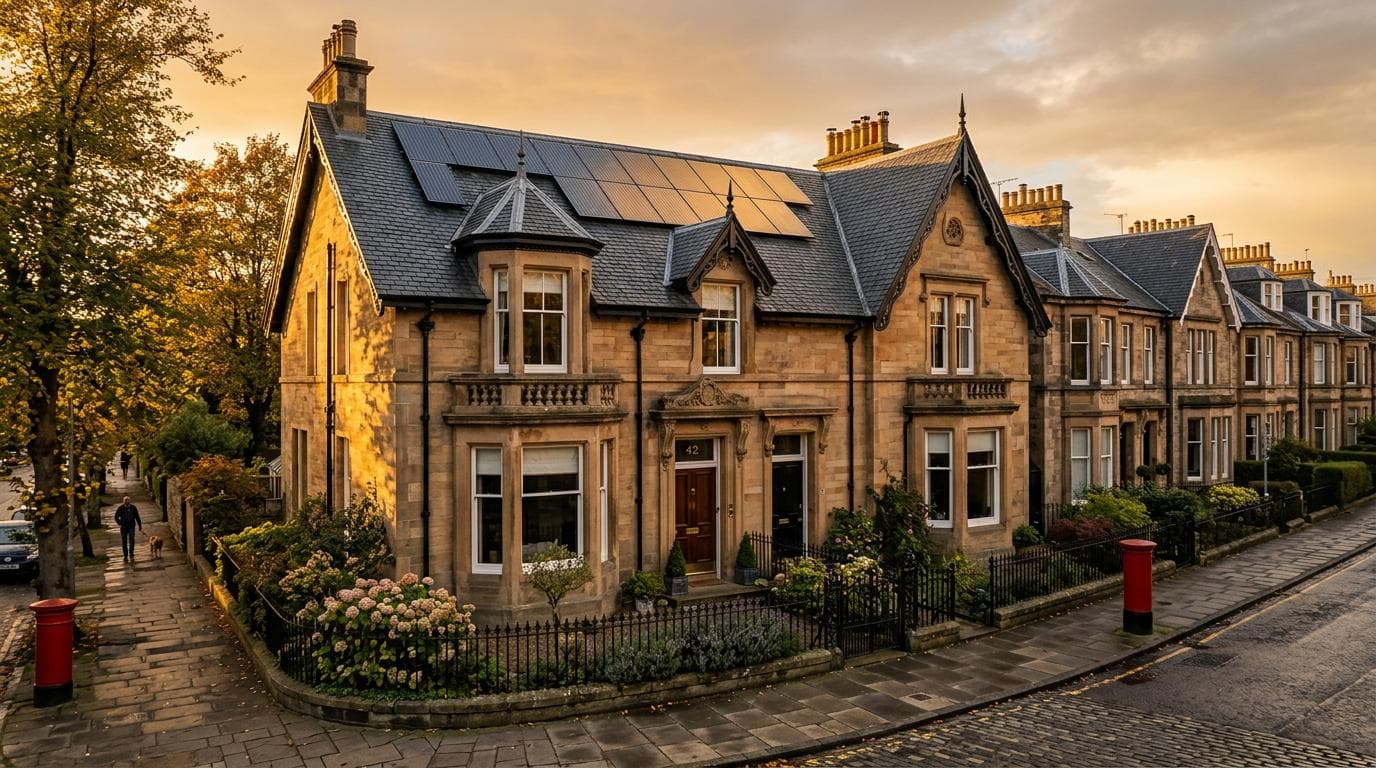
Do Solar Panels Actually Work in Scotland's Weather? The 'Edinburgh Haar' Truth
Calum Pentland
Co-Founder, Pentland Renewables
If you live in Edinburgh, you know the 'Haar'—that thick, cold sea fog that rolls in from the Firth of Forth. You also know our 'four seasons in one day' weather pattern. It's the #1 reason homeowners hesitate to install solar panels. The logic seems sound: "If I can't see the sun, my panels can't work."
But here is the truth: Solar panels don't need direct heat or even direct sunlight to generate electricity. They need daylight. In this article, we'll look at the data and explain why Edinburgh is actually a prime location for solar energy.
The Reality Check
- Solar panels work on light, not heat—cloudy days still provide "diffuse light"
- Edinburgh receives ~1,400 sunshine hours, comparable to parts of Germany (the solar world leader)
- Solar panels are actually more efficient in cooler Scottish temperatures than in extreme heat
- The "Haar" reduces output, but doesn't stop it—modern inverters are designed to handle variable light
- High-quality Tier 1 panels (like the ones we install) are optimised for overcast conditions
Light vs. Heat: How Solar Actually Works
It's a common misconception that solar panels need a 'scorcher' of a day to perform. In reality, solar panels are semiconductor devices. They convert photons (light particles) into electrons (electricity).
There are two types of light: **Direct** and **Diffuse**. While direct sunlight (clear blue skies) is optimal, diffuse light (light scattered by clouds or fog) still contains enough photons to generate significant power. On a typical overcast Edinburgh day, a system will still generate 10% to 25% of its peak capacity.
The "Cooler is Better" Advantage
Here is a secret the national installers won't tell you: Solar panels hate extreme heat. Like any electronic device, they lose efficiency as they get hotter. When a roof in London hits 40°C in July, their panels can lose up to 15% of their efficiency.
Masterclass Insight
The ideal condition for solar isn't a heatwave; it's a bright, crisp, cold day. Edinburgh's spring and autumn are perfect for high-efficiency generation.
Dealing with the 'Edinburgh Haar'
We've all seen the Haar swallow the Castle. Yes, heavy fog reduces visibility and light, but it doesn't turn off the sky. Modern 'all-weather' panels use anti-reflective coatings and advanced cell structures to capture as much light as possible from different angles.
Data from our monitoring systems across Leith and Portobello shows that even during the foggiest mornings, systems are still 'waking up' and trickling power into batteries. By the time the Haar lifts at midday, the system is ready to ramp up to full power.
Why Scotland Outperforms its Reputation
If solar didn't work in cloudy climates, Germany—which has a very similar light profile to the UK—wouldn't be the global leader in residential solar. The economics in Edinburgh work because our electricity prices are high, and the Scottish Government provides the best grants in the UK to encourage adoption.
“I was worried the panels wouldn't pay off in Leith, but even on grey days, we're seeing enough generation to run the dishwasher and keep the battery topped up.”
\u2014 David, Leith Links
Conclusion: Don't Wait for the Sun
Waiting for a 'sunny' climate is a mistake that costs you hundreds in energy bills every year. The tech is now at a point where the Scottish weather is no longer a barrier. If you have a roof and it's daylight, you could be saving money.
At Pentland Renewables, we use specialist simulation software that accounts for Edinburgh's specific weather files. We won't give you a generic quote; we'll give you a generation forecast based on actual light data for your specific postcode.