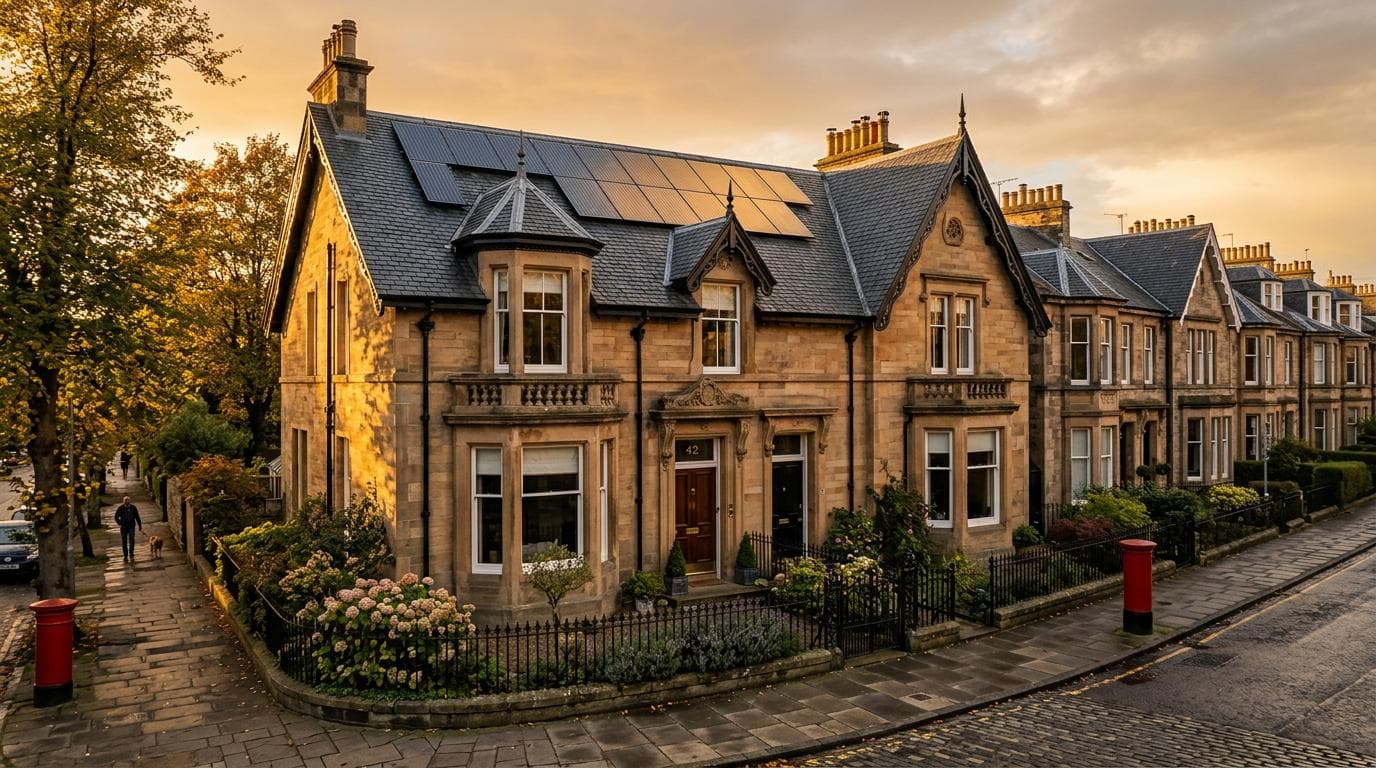
Restoring Edinburgh Sandstone: Solar PV & Heat Pumps for Historic Homes
Calum Pentland
Co-Founder, Pentland Renewables
Edinburgh and the Lothians boast some of Europe's most pristine historic architecture—from grand Victorian sandstone villas in Morningside to Georgian terraces in the UNESCO New Town, and traditional coastal cottages in North Berwick. However, traditional solid sandstone properties present unique physical, thermal, and regulatory challenges for standard renewable energy upgrades.
Too often, historic homeowners are told by national installers that their properties are 'unsuitable' for solar panels or heat pumps, or they are scared off by the sheer bureaucratic friction of local planning consent. At Pentland Renewables, we reject this defeatism. With surgical design, custom marine-grade hardware, and deep understanding of sandstone thermodynamics, we successfully modernise Scotland's heritage homes while fully preserving their architectural character.
Historic Retrofitting Essentials
- Permitted Development exists in most conservation areas if arrays are placed on non-street visible pitched roofs or flush-integrated.
- Traditional sandstone possesses exceptional thermal mass—meaning heat pumps should be calibrated for low, continuous heat emission rather than rapid on-off cycles.
- Marine-grade anodized aluminum mounts and salt-resistant cables are mandatory to prevent salt-spray degradation near the coast.
- Surgical in-roof GSE systems allow solar panels to sit completely flush with your slates, preserving the roofline silhouette.
1. Navigating Conservation Planning in the Central Belt
The single biggest hesitation for traditional homeowners is planning permission. Edinburgh’s Article 4 Directions and strict Conservation Area guidelines limit standard Permitted Development rights. However, the planning rules are highly logical if navigated with professional care:
For unlisted properties within conservation zones, solar panels are permitted without planning consent provided the array is not mounted on a street-visible elevation or does not project more than 200mm from the roof plane. At Pentland, we specialize in flush-fitting slate systems and rear-valley installations that are completely hidden from public roads, satisfying both local bylaws and aesthetic standards.
“If your building is Category A or B listed, full listed building consent is required. However, Historic Environment Scotland is highly supportive of clean energy transitions. We have successfully secured approvals by placing ultra-sleek, all-black solar tiles directly behind Georgian roof parapets, rendering the entire system 100% invisible from street level.”
2. Sandstone Thermodynamics: Calibrating Heat Pumps for High-Mass Homes
Traditional solid sandstone walls (often 600mm thick) behave very differently from modern insulated cavity walls. Sandstone acts as a dense, high-capacity thermal sponge—it absorbs heat slowly but retains and radiates it over long periods. This high thermal inertia is an asset if managed correctly, but a disaster if paired with a poorly calibrated heating system.
Standard gas boilers work by running short, aggressive bursts of high-temperature water (65°C to 75°C) to quickly warm up rooms. National installers often try to mirror this behavior with heat pumps, leading to massive electricity bills and freezing rooms. Air source heat pumps are low-temperature systems designed to work at their highest efficiency (Coefficient of Performance) when operating continuously at flow temperatures of 35°C to 45°C.
Masterclass Insight
Surgical COP Calibration: To heat a sandstone property efficiently, we calibrate your heat pump's weather compensation curves to run at a low, stable, continuous output. Rather than heating the air rapidly, the system heats the dense sandstone walls, creating a constant, comfortable radiant heat blanket throughout the home.
3. Maritime Climate Hardening: Marine-Grade Hardware Standards
Properties in Edinburgh, Musselburgh, Portobello, and North Berwick are highly exposed to severe North Sea salt winds and high-velocity wind loads. Standard silver-aluminum racking and zinc-plated brackets will corrode within 5 years under these harsh coastal conditions, causing rust stains to run down your pristine slates and slate failure.
To combat this coastal degradation, Pentland Renewables enforces a strict marine-grade installation standard. We utilize exclusively anodized marine-grade aluminum mounting hooks, double-lock stainless steel rafters, and fully weather-sealed salt-resistant cabling. We perform wind-load structural simulations on every single design to guarantee your solar array stands firm against winter gales.
4. Navigating Shared Roofs & Co-Owner Factor Sign-Offs
For tenement flats, the roof is legally considered a common repair. To install solar panels on a shared roof, you must typically secure agreement from a majority of co-owners or your property factor. While this sounds daunting, we provide a complete co-owner information pack detailing exact roof-weight parameters, fire-safe compliance certifications, and clear maintenance split models to make factor sign-off entirely seamless.
We take care of the structural assessments to prove our ultra-light racking places zero structural strain on the shared timber rafters, giving factors and tenement associations absolute peace of mind.
🔒 Claim Your Free Heritage Thermal Audit
Your home is a work of architectural art. It deserves specialized engineering, not a rushed corporate sales pitch. Book a free, no-obligation physical roof and thermal loss audit by a master Pentland technician to map out your custom HES grant and planning roadmap.
- Walk-In: 14 Rodney Street, Edinburgh
- Call a Master Design Engineer: 0131 555 0198
- Email: hello@pentlandrenewables.co.uk
- Run the Retrofit Wizard: www.pentlandrenewables.co.uk/retrofit-planner